
Design You Can Feel: How Graphic Design Shapes the Customer Experience

Your customers are forming opinions about your brand before they read a single word.
They notice the package. The color. The photography. The paper. The way information is organized. They notice how something feels in their hands and how easy it is to understand.
They may not consciously analyze those details, but they respond to them.
That is why graphic design should not be treated as the final step that makes a marketing piece look good. Design is part of the customer experience. Done well, it can make your brand easier to understand, more recognizable, more credible and more memorable.
For brand managers, the opportunity is to think beyond what something looks like and ask a more valuable question:
What do we want our customers to experience?
Start With the Feeling, Not the Format
Before deciding on colors, photography, paper or finishes, decide how you want the customer to feel.
Should your brand feel established and trustworthy? Innovative and unexpected? Premium? Approachable? Energetic? Sophisticated?
That answer should influence the creative decisions that follow.
Imagine two companies selling comparable premium products. One arrives in a thoughtfully designed package with restrained typography, substantial materials and carefully considered details. The other arrives in generic packaging with inconsistent branding.
Before either customer uses the product, the packaging has already influenced their perception of its value.
Design creates expectations.
A useful exercise at the beginning of your next project is to complete this sentence:
“When our customer sees, holds or opens this, we want them to feel ______.”
If your creative choices do not reinforce that answer, it may be worth reconsidering them.

Make It Easy for Customers to Know Where to Look
Beautiful design that makes information difficult to understand is not effective design.
One of graphic design’s most important jobs is creating hierarchy.
Customers should quickly understand:
What is this? Why does it matter to me? What should I look at next? What should I do?
Consider a direct mail piece.
The recipient may only give it a few seconds of attention initially. A strong visual hierarchy can move the eye naturally from the headline to the primary benefit, then to the offer and finally to the call to action.
Packaging works similarly. The brand, product name and most important differentiator should not all compete equally for attention.
Before approving a design, try the five-second test. Look at it briefly, then look away.
What did you notice first? What did you remember? Was it the thing you wanted your customer to notice?
If not, the design may need more work.
Design for the Entire Customer Journey
Customers rarely encounter your brand in just one place.
Someone might see an online ad, visit your website, receive a direct mail piece, encounter your product on a shelf and eventually open a package at home.
Each touchpoint contributes to the same brand perception.
The goal is not to make every piece identical. It is to make every interaction feel like it came from the same brand.
Look across your customer-facing materials and ask:
Would someone recognize us without seeing our logo?
Color, typography, imagery, messaging, materials and overall personality should create a recognizable visual language.
Consistency builds familiarity, and familiarity can help build confidence in your brand.
Use the Physical Experience to Your Advantage
Print and packaging offer something digital experiences cannot fully replicate: touch.
That creates another set of design tools.
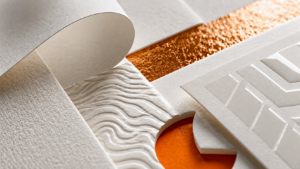
Paper stocks, substrates, coatings, embossing, debossing, foil, specialty inks, dimensional effects and structural design can all influence how someone experiences your brand.
The key is not to use a special effect simply because you can.
Use it because it communicates something.
A soft-touch coating might reinforce a premium positioning. An embossed element can create emphasis through touch. An unexpected fold can encourage discovery. A heavier stock can communicate substance. A carefully engineered package opening can create anticipation.
Ask yourself:
If the customer closed their eyes and held this piece, would the physical experience still say something about our brand?
That is where print becomes more than a delivery mechanism. It becomes part of the message.
Design for the Real World
A design can look fantastic on a monitor and behave very differently once it becomes a physical object.
Colors interact with substrates. Folds change how information is revealed. Finishes affect contrast. Packaging structures determine what customers see first. Postal requirements can influence direct mail formats. Production choices can create opportunities that may never occur to a creative team working exclusively on screen.
This is why production should not always enter the conversation after the design is complete.
Bringing designers and production experts together earlier can reveal possibilities that improve both the creative concept and the finished experience.
Instead of asking, “Can you produce this design?”
Try asking, “What could we do with this idea that we haven’t considered yet?”
That question can lead somewhere much more interesting.
Five Questions to Ask Before Your Next Design Project
Before approving your next package, mailer, brochure, sales kit or branded piece, ask:
- What do we want the customer to feel?
- What should they notice first?
- Is it immediately clear what we want them to understand or do?
- Does this feel unmistakably like our brand?
- Are we using the physical format to improve the experience?
If you can answer all five confidently, you are no longer thinking about design simply as decoration.
You are designing the customer experience.
Design You Can Feel
At SunDance, we believe some of the most effective creative ideas happen when design and production are considered together.
Our creative team can think beyond what appears on the screen to consider how a piece will ultimately be printed, folded, finished, mailed, displayed, opened and held. That connection gives brands an opportunity to use materials, print processes, finishing techniques and structural ideas as part of the creative concept itself.
Because your customers do not experience your brand as a collection of fonts, colors, images and materials.
They experience how all of those things make them feel.
And that is where great design can make a difference.

Holly Picano is the AI & Digital Marketing Manager at SunDance, a 2x Forbes-featured GenAI author on Amazon, Marquis Who’s Who honoree for digital innovation, and recipient of Disney’s prestigious Partners in Excellence award, presented to fewer than 2% of cast members worldwide.